Operate your AI workforce from the tools you already use.
Build explicit HTTP automation with Yodu's public REST API, or connect Claude Code, Claude Desktop, Cursor, and other MCP clients to one workspace through 53 curated tools.
Public REST API
Use documented HTTP resources for workspace context, employees, memory, tasks, channels, approvals, schedules, runtime visibility, and tools.
https://app.yodu.ai/api/*Run the REST quickstartPlatform MCP
Let a compatible AI client discover named tools for reading the workspace, creating work, configuring employees, and installing write-only credentials.
https://app.yodu.ai/api/mcpConnect an MCP client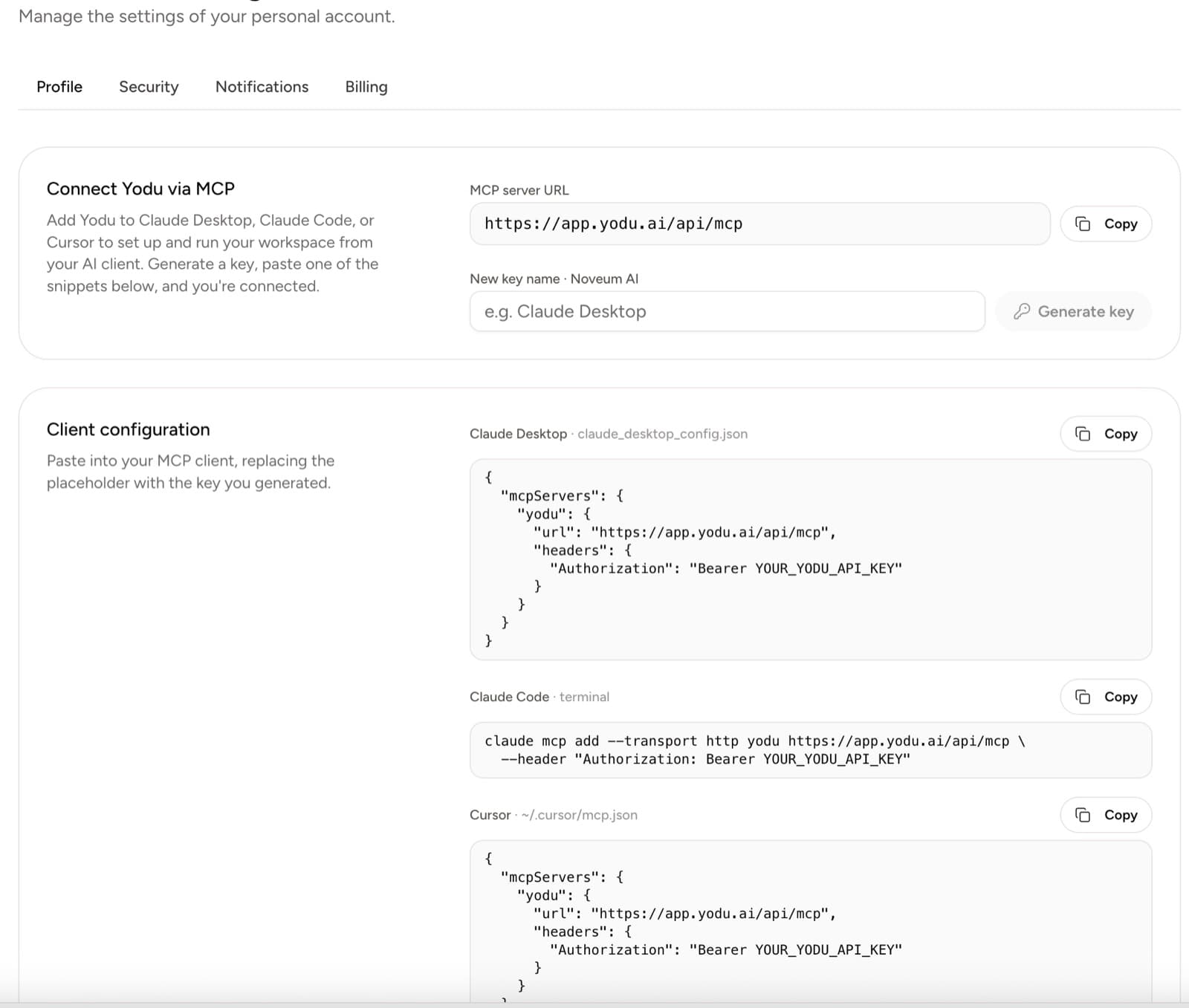
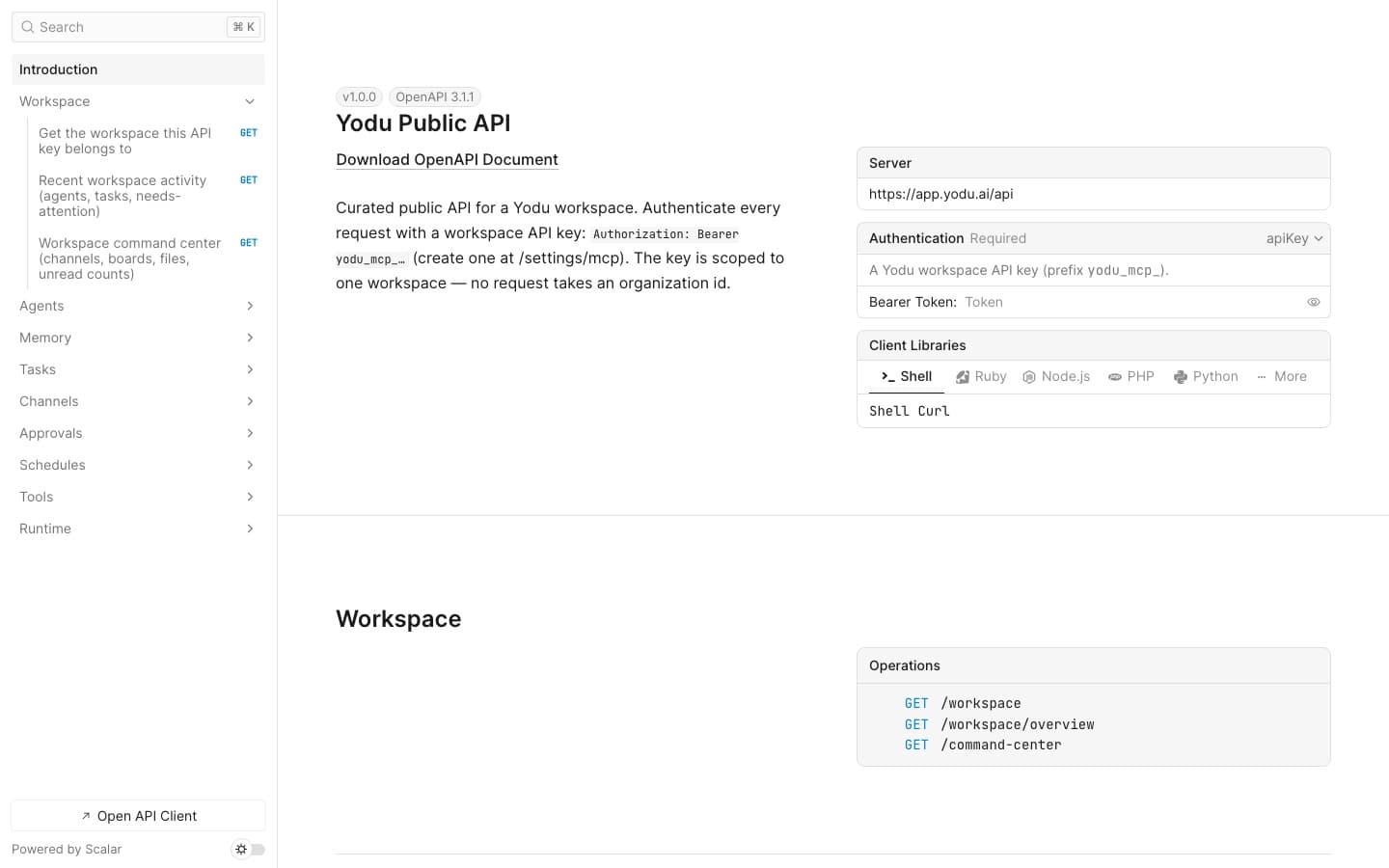
The live contract is inspectable before you write code.
Explore request and response schemas in the interactive reference, or consume the OpenAPI document directly. The public surface is a curated allowlist, not a private application API in disguise.
Workspace
/workspace · /workspace/overview
Employees
/agents
Memory
/memory · /memory/{id}
Tasks
/tasks · /tasks/{id} · /tasks/{id}/comments · /tasks/{id}/move
Channels
/channels/{channelId}/messages · /channels/{channelId}/activity · /channels/{channelId}/mark-read
Operations
/approvals · /scheduled-jobs · /runtime/health · /runtime/state
Tools
/tools · /tool-catalog
Enough control to operate the workspace. Clear boundaries around everything else.
Every tool derives its workspace from the verified key. Members can read and create work; owner or admin access is required for employee configuration and protected credentials.
Read the workspace
22Inspect workspace identity, employees, role templates, memory, tasks, runtime health, and configured secret metadata without revealing values.
- get_workspace
- get_workspace_overview
- get_workspace_settings
- list_agents
- list_secrets
- list_role_templates
- list_agent_configs
- list_models
- get_agent_skills
- list_connected_tools
- list_agent_files
- list_memory
- read_memory
- list_tasks
- read_task
- get_runtime_health
- get_runtime_state
- get_runtime_command_status
- list_custom_mcp_servers
- list_scheduled_jobs
- list_cloud_agent_connections
- get_cloud_agent_setup_guide
Create useful work
6Create and update durable memory, then add assigned work to the task board.
- create_memory
- update_memory
- create_task
- update_task
- move_task
- comment_task
Configure employees
19Recruit, provision, and set operating documents, autonomy, models, skills, and safe custom skill or script files.
- activate_memory
- set_memory_status
- create_agent
- provision_agent
- repair_workspace_runtime
- set_workspace_model_routing
- set_workspace_runtime_resources
- set_agent_autonomy
- write_agent_config
- set_agent_model
- set_agent_role
- set_agent_skills
- set_agent_cloud_coding
- set_agent_tool_access
- create_scheduled_job
- update_scheduled_job
- delete_scheduled_job
- run_scheduled_job
- write_agent_file
Install protected access
6Register custom MCP access and store provider, workspace, or employee credentials without reading values back.
- add_custom_mcp_server
- remove_custom_mcp_server
- set_model_provider_key
- connect_cloud_agent
- connect_cloud_coding_repo
- set_workspace_secret
Security boundaries are part of the interface
One key. One user. One workspace.
Current settings-created keys carry all three scopes. Every request still checks the fixed workspace, current membership, and manager role; secret values are write-only, and sensitive administration never enters the public surface.
workspace:readRead workspace context, work, employees, memory, and operational health.
workspace:writeCreate work and memory, and configure employees when the user is a manager.
secrets:writeStore protected configuration as an owner or admin; never reveal it later.
Start with one read-only call. Expand only when the workflow earns it.
Create a workspace, generate a client-specific key, confirm the workspace identity, and follow a bounded recipe from the public documentation.