#ai-employees#operations#founders
How to run a company with AI employeesA practical operating model for giving AI employees real jobs, context, tools, recurring work, and review without losing human control.
Yodu team
Yodu team
Updated · 5 min read
The goal of your first week is not to hire ten AI employees. It is to complete one useful loop you can inspect from brief to accepted output.
McKinsey reported in 2026 that nearly two-thirds of enterprises had experimented with agents, but fewer than 10% had scaled them to tangible value. The lesson for a small company is not “move slowly.” It is “prove the workflow, not the demo.”
Here is a practical seven-day plan.
Manage your first AI employee by proving one low-risk workflow in seven days: define the task, add company context, configure model access, hire one role, connect one tool, move the work through review, and compare the accepted result with the old process. Do not add more roles until that loop works.
The reason to start narrowly is not lack of potential. An NBER field study found generative AI assistance increased support-agent productivity by nearly 14% overall, but the effect varied sharply by worker experience. Your own role, context, and review process determine whether a result transfers.
Write down ten tasks that consume founder or team time. Choose one that is:
Good first assignments include a competitor brief, account research, a content outline, support-theme summary, or issue investigation.
Write the expected output in one sentence. If you cannot, the task is not ready.
Create the company profile in Memory. Cover:
Add only the context the first role needs. Link source files instead of pasting every company document into one memory page.
Success check: a new human teammate could read the profile and explain the company accurately.
Open Organization settings → Yodu and add one provider you are authorized to use.
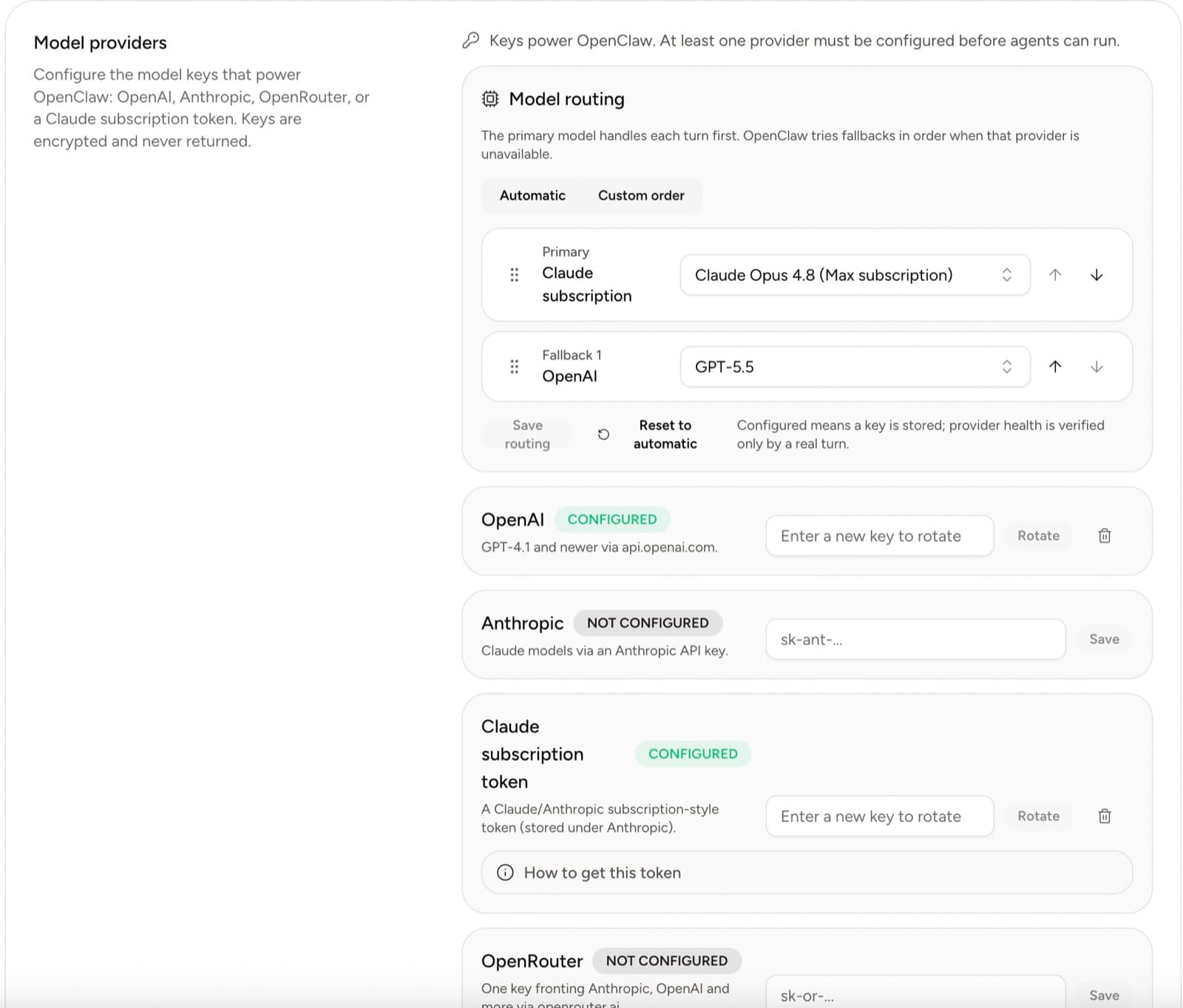
Choose an available model for the first employee. Do not spend the day benchmarking every model. Use one that meets the job, then measure accepted output.
Success check: the employee replies and the runtime remains healthy after the model change.
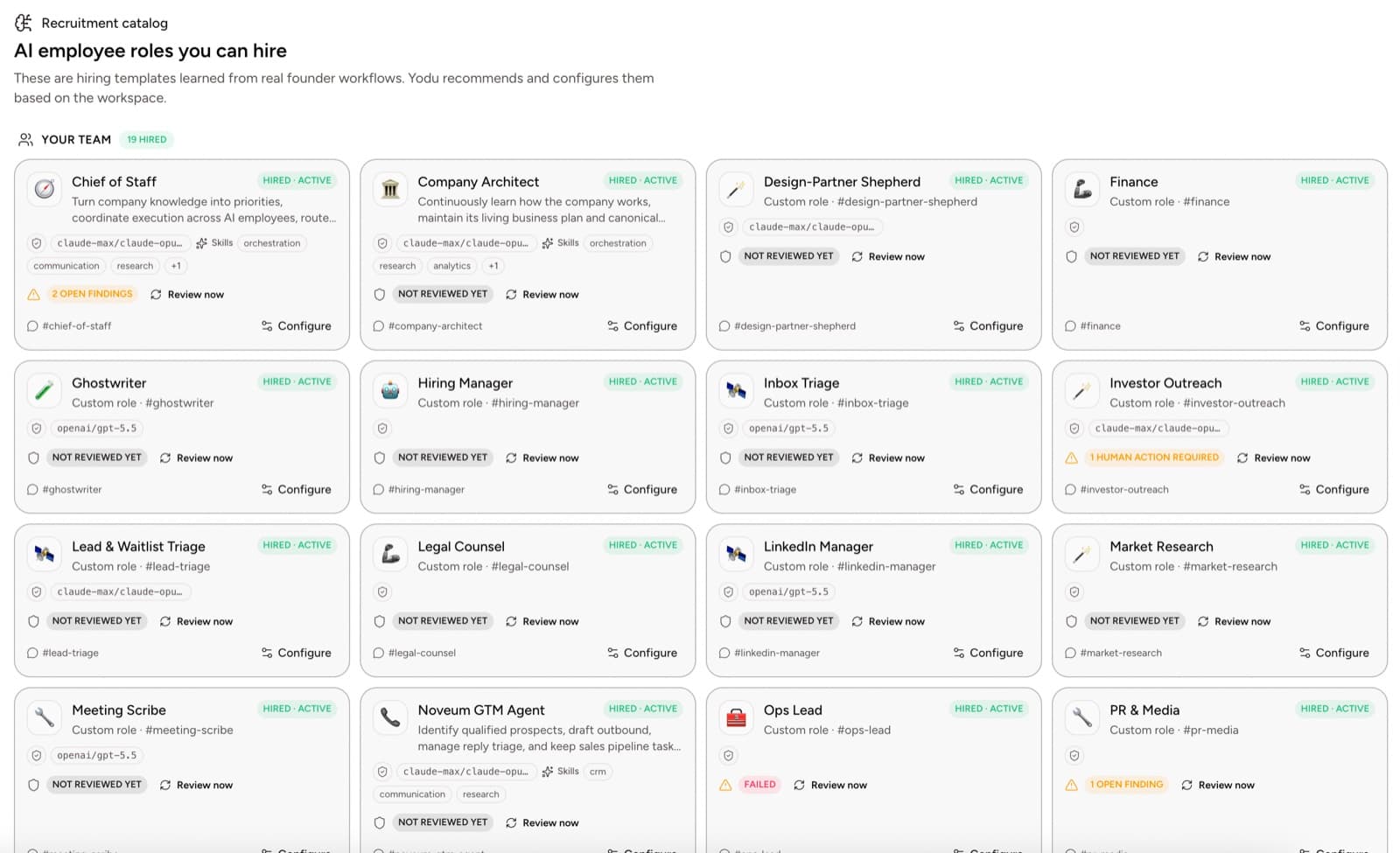
Open AI employees and choose the role closest to the work.
Configure:
Success check: the employee can explain its job in practical terms, not broad promises.
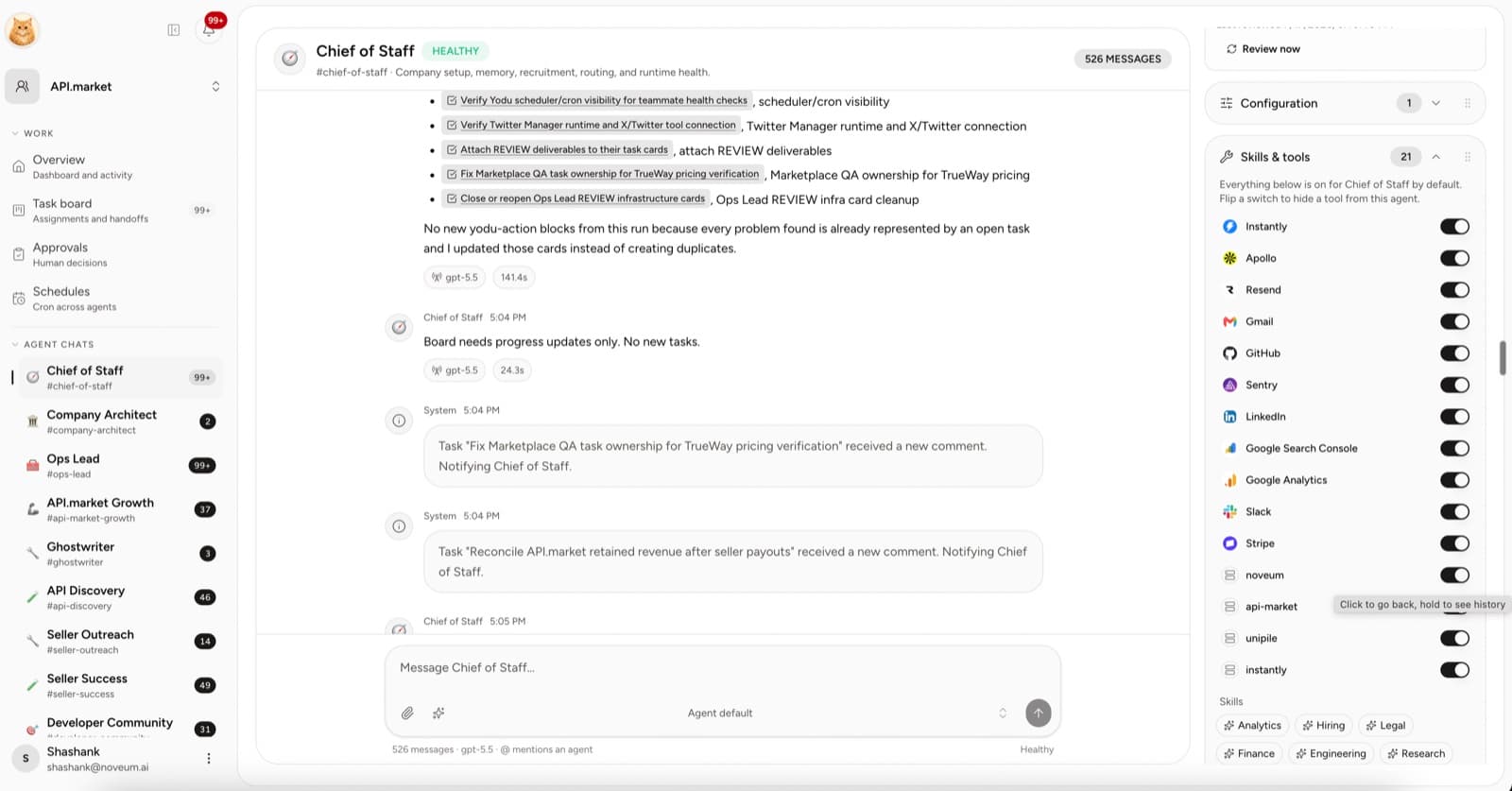
Open Tool access → App catalog. Connect only the account needed for the first assignment.
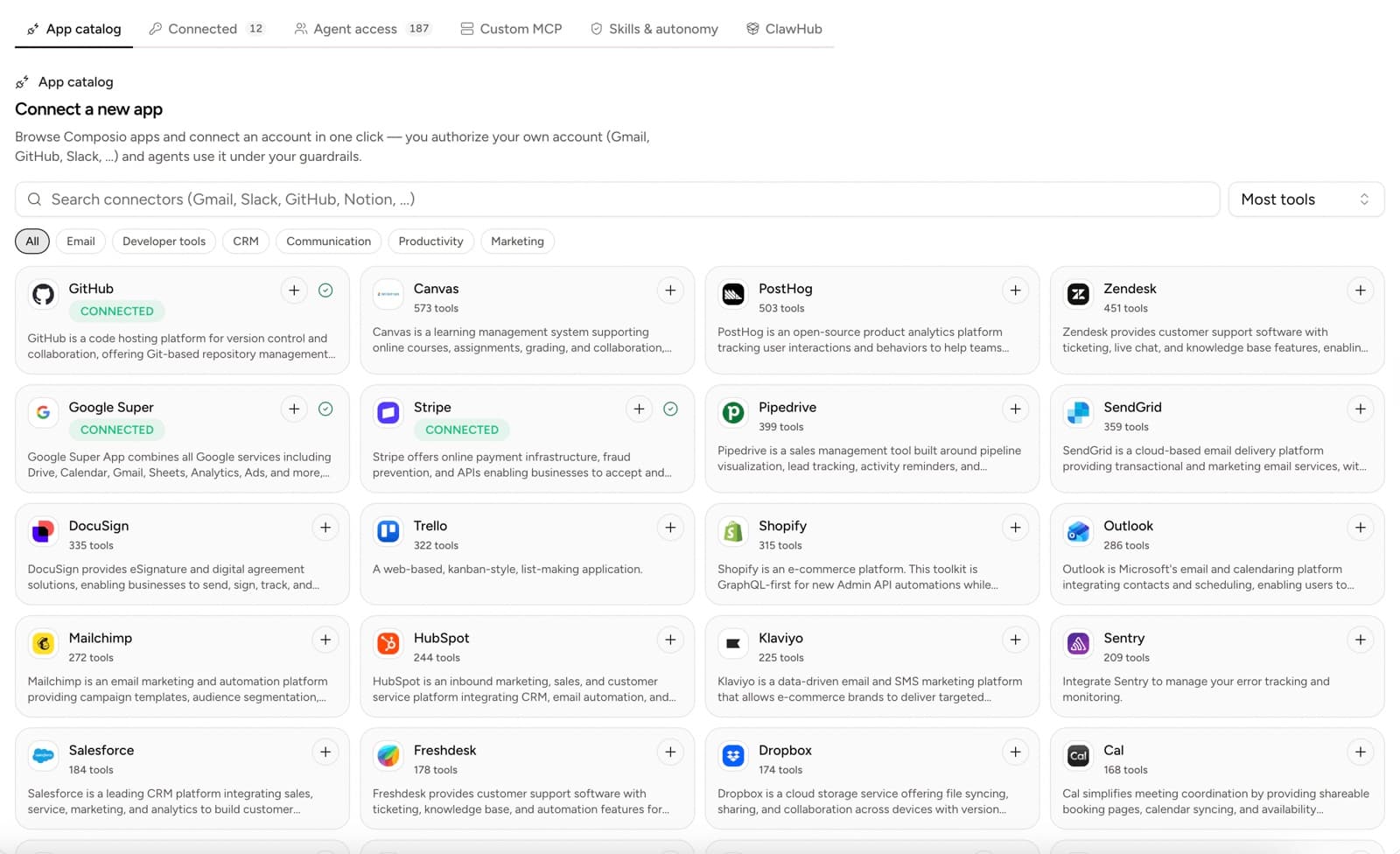
The connected app is switched on for the employee by default; each employee's Skills & tools panel holds one on-off switch per tool. With one employee hired there is nothing to narrow yet. Safety comes from the approval gate, which pauses external actions for your decision.
Examples:
| Role | First tool | The gate will hold | | -------------------- | ----------------- | --------------------------- | | Research analyst | CRM or files | Nothing, the work reads | | Sales operator | Gmail | Email sends | | Support lead | Inbox or helpdesk | Outbound replies | | Engineering operator | GitHub | Repository writes | | Finance operator | Stripe | Refunds and billing changes |
Success check: the employee can read or draft with the intended account and cannot take an unapproved external action.
Create three cards:
The third card tests whether the employee asks for context instead of inventing it.
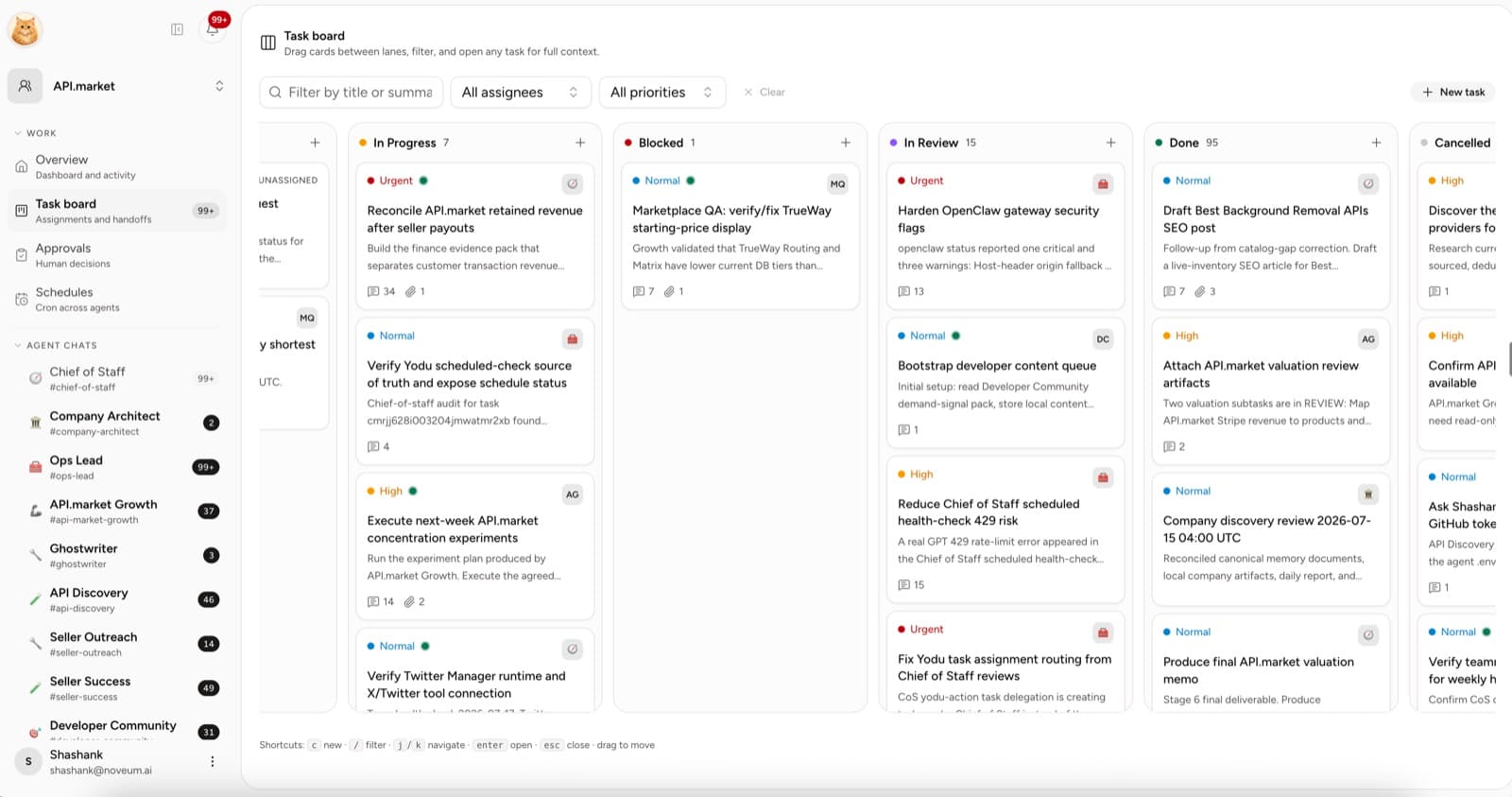
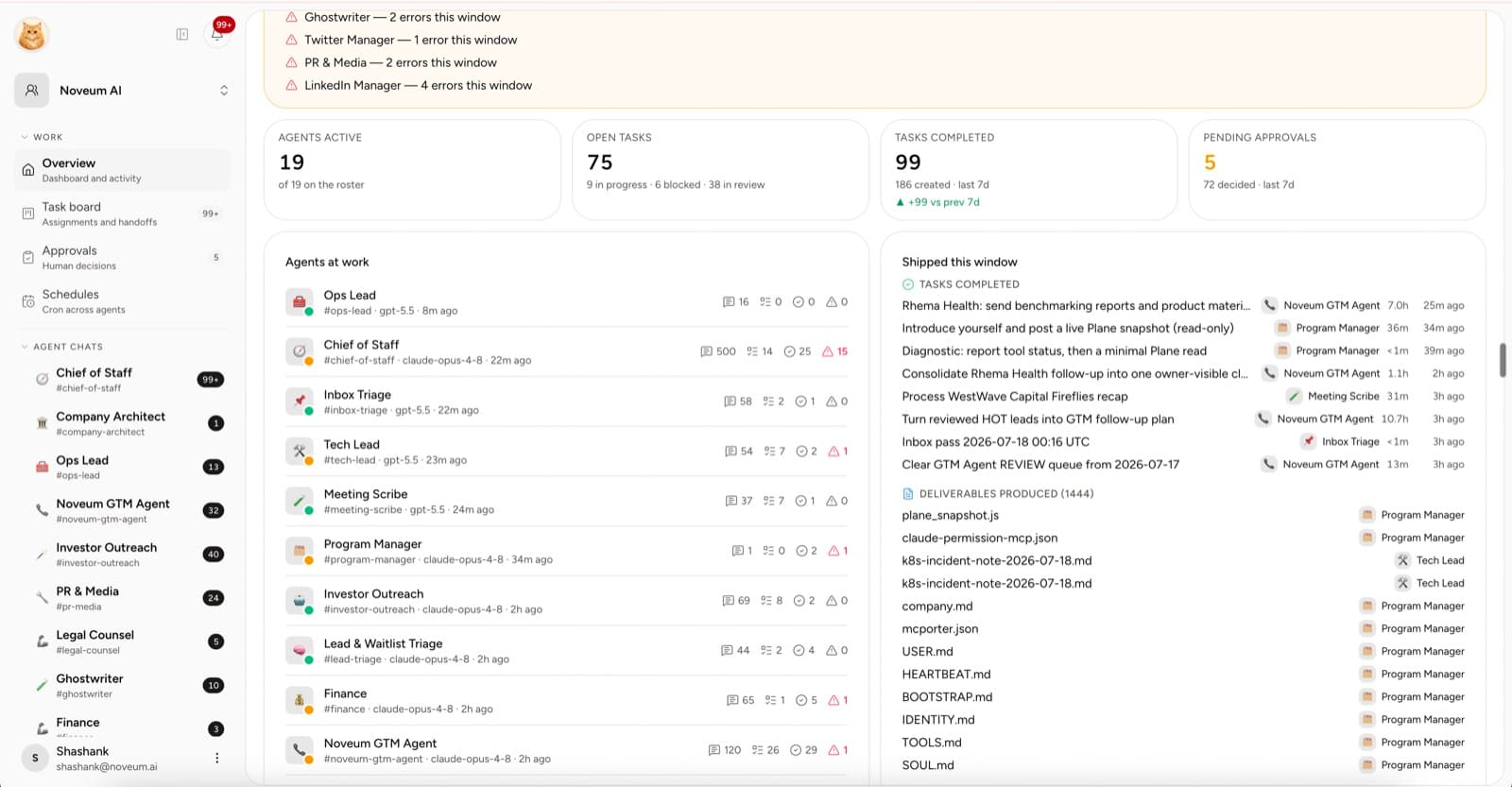
Move the primary assignment into Todo and assign the employee. Keep the expected output and source files on the task.
Success check: the work has an owner, status, and review destination.
Score the output from 1 to 5:
| Area | Question | | --------- | --------------------------------------------------------------- | | Accuracy | Are important claims supported by the supplied sources? | | Relevance | Did the employee solve the assigned task? | | Usability | Can a human use the output without rebuilding it? | | Style | Does it fit company guidance? | | Control | Did the employee use only enabled tools and pause for approval? |
Record the corrections on the task. Update company memory only when the correction is a durable company fact. Update the role or skill when the correction is about how the job should be done.
Track:
Do not compare the week to a hypothetical perfect employee. Compare it to the way the work happened before: founder time, delay, missed follow-up, and coordination cost.
If the first loop works:
If it does not work, do not add more employees. Fix the brief, context, sources, or access and run the same class of task again.
The first week is successful when you have one role you understand, one workflow you can measure, and one piece of work you would genuinely have paid someone to complete.
Use the first-workspace setup guide, define the ROI scorecard, then read the operating model for running a company with AI employees before expanding the team.
Practical guides related to this workflow.
A practical operating model for giving AI employees real jobs, context, tools, recurring work, and review without losing human control.
Yodu team
A practical comparison of chat assistants, workflow automation, and AI employees with roles, context, tools, tasks, files, schedules, and approval rules.
Yodu team
A visual tour of the workspace where founders talk to AI employees, manage tasks, inspect files, configure access, and review recurring work.
Yodu team